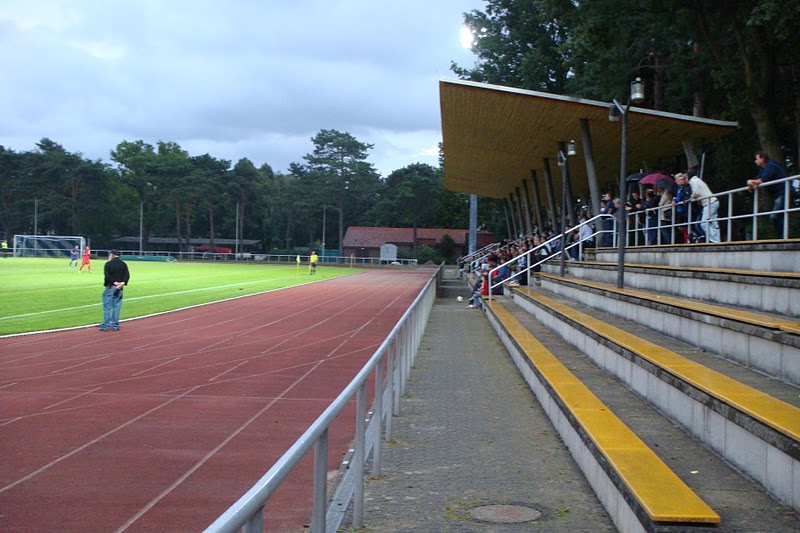
(Berlin-Liga, 12. August 2011)
CLUB HISTORY: (wiki)
The Hertha Zehlendorf is a German association football club from the suburb of Zehlendorf, Berlin.
The club, one of the largest football clubs in the country, has a strong youth department which has developed a number of international players, not just for Germany and having won two national youth championships.
1903–1945
The club was formed by 30 local football enthusiasts on 10 March 1903, under the name of Tor- und Fußballclub Germania 03 Zehlendorf. By 1909, it had however changed its name to FC Hertha Zehlendorf. In 1913, the club moved to a new ground, Siebenendenweg, now called Ernst-Reuter-Sportfeld, away from the Tempelhofer Feld, where it was never entirely happy. The team was for a time part of BFC Hertha 1892 but by September 1914 the club became independent again, under the name of FC Hertha 06 Zehlendorf.
After the end of the First World War, in January 1919, the club merged with local side VfB Zehlendorf 03 to form the current club, FC Hertha 03 Zehlendorf. It was from this union, Hertha derives its foundation date, too.
For the next decade, the club did not particularly stand out of the ranks of Berlin football clubs. Only in 1933 could it finally win a championship in the local Kreisklasse but the change in the German football league system, the introduction of the Gauligas, prevented the team from being promoted.
The club continued to struggle throughout this age and even had to form an on-the-field union with Union Lichterfelde to survive. During the Second World War, play came almost completely to a halt.
1945–1963
After the war, all previously existing clubs and associations were outlawed in Berlin and the former Hertha existed under the name of SG Zehlendorf for a while. It entered the Amateurliga Berlin (II) in 1947, a league that was played in a number of regional groups. It however became the first club in Berlin to receive a license in 1948 to revert to its original name by the allied occupation authorities.
On the field, the club qualified for the single-division Amateurliga in 1950 and immediately became a strong side in this league, winning the championship in 1953. The clubs youth side took out its first Berlin championship in 1950, a game played as a curtain raiser for a Germany versus Turkey friendly, in front of 60,000, on 17 June 1951. Germany lost 1–2, but Zehlendorf beat Hertha BSC 3–2.
The team entered the tier-one Oberliga Berlin for the 1953–54 season, were all the big names of West Berlin football were playing in those days. It found life at this level much harder and was immediately relegated again, finishing 11th out of 12 teams. Back in the Amateurliga, another championship was won and the club earned the right to return to the Oberliga.
In this league, the team would stay until 1963, earning lower table finishes each season but surviving nevertheless.[5] Hertha in this time earned much more local success with its youth teams, a fact not much changed even today, winning Berlin championship in various age groups over the years.
1963–74: Regionalliga years
In 1963, German football was fundamentally changed with the introduction of the Fussball-Bundesliga. Below it, five regional leagues, the Regionalligas, were formed. Hertha did not apply for a spot in the new Bundesliga as only one club from Berlin was admitted and the bigger names in local football, Hertha BSC and Tasmania 1900 far out qualified the little club.
Instead, the club qualified for the new tier-two Regionalliga Berlin, a league it would belong to until its disbanding in 1974. In this league, Hertha continued its existence as an average side, at least for the first couple of seasons. From 1965, the clubs results improved and it developed into an upper table side.
In 1968–69, the team archived its greatest success so far, winning the Regionalliga and thereby qualifying for the promotion round to the Bundesliga. In this competition, the club came fourth out of five teams, when only the winner, Rot-Weiß Oberhausen, qualified for promotion.
The following season, the team repeated its success; winning the league once more and getting another try at Bundesliga promotion. The club finished one rank better this time, coming third but the Bundesliga spot went to Kickers Offenbach. The club took out the second edition of the German under-19 championship that year, a huge success for the Hertha.
From 1970 onwards, the club returned to its mid-table existence, staying out of relegation trouble but also not really in contention for another championship either. In 1970–71, Tasmania 1900 was all to dominating anyway, winning the league title and going broke two seasons later.
For Hertha, the year 1974 was the last as a second division team, the introduction of the 2nd Bundesligas meaning the end for the five Regionalligas. To qualify for the new 2nd Bundesliga Nord, the club had to be one of the two top clubs in its league but a fourth spot was not enough and it was demoted to the tier-three Amateurliga Berlin instead.
1974–current
Hertha missed out on the league championship there in its first season, coming second by a point to Spandauer SV, who won promotion to the second division. The next three seasons, the club spent in midfield but its youth teams once more impressed, reaching the final in both the under-19 and the under-17 German championships in 1978.
In 1978–79, it managed to win the league. This entitled the club to take part in the promotion round to the 2nd Bundesliga. It had to play OSC Bremerhaven and beat the opposition 5–4 in Berlin. In Bremerhaven it held a 0–0 until four minutes from the end, seeing itself already in the second division but then OSC scored the winning goal and earned promotion on the away goal rule. Its Berlin title qualified the club for the German amateur football championship, too, where it went all the way to the final and lost to ESV Ingolstadt.
The club continued to be a driving force in what was now renamed Amateur Oberliga Berlin, finishing in the top five all but once in the next twelve seasons. In 1981–82, another highlight followed, coming second in the league to Tennis Borussia Berlin, on equal points but falling nine goals short. The team returned to the German amateur championship, where the FSV Mainz 05 proofed to strong in the semi-finals, winning both games. Thirdly, the club also qualified for the German Cup on the strength of a Berlin Cup win. It drew Hertha BSC for the first round and, in front of 12,000 spectators, the score was two all after regular time but then the big Hertha scored two more goals and knocked the little Hertha out of the cup. Little Hertha (German: Kleine Hertha) is the long-standing nickname of the club, referring to the fact that Hertha BSC was always the bigger and more successful of the two Herthas.
The season after, the club came second in the league once more, this time to SC Charlottenburg, and earned another shot at the amateur championship but this time, the FC Bayern Munich II in the first round was as far as it went.
In 1988, the clubs under-17's finally took out the German championship, beating southern powerhouse VfB Stuttgart 2–1 in the final. The year after, wealthy FC Bayern Munich managed to beat the amateur clubs youth team on penalties only in the final.
From 1988 to 1990, the Oberliga Berlin became the scene of Herthas struggle with Reinickendorfer Füchse for the league championship but both times Reinickendorf won the upper hand. Each time, Hertha only earned the right to compete for the amateur championship again and each time it lost in the first round.
1990–91 was the Oberliga Berlins last season, the German reunion also affected football and the NOFV-Oberliga was established instead. Hertha became part of the NOFV-Oberliga Mitte, a league dominated by 1. FC Union Berlin in its short three year existence and Zehlendorf managed only average performances. Nevertheless, it did qualify for the new tier-three Regionalliga Nordost in 1994. In a league full of former East German football powerhouses, the team struggled for four seasons before being relegated in 1998.
The club managed to only survive two seasons in the NOFV-Oberliga Nord (IV) before another relegation, now to the tier-five Verbandsliga Berlin. It has since spent its time in this league, earning places in the upper half of the table but not being able to win another league championship.
HONOURS:
German amateur football championship
Runners-up 1979
Regionalliga Berlin (II):
Winners 1969, 1970
Amateurliga Berlin (II):
Winners 1953
Oberliga Berlin (III):
Winners 1979
Runners-up 1975, 1982, 1983, 1989, 1990
Berlin Cup:
Winners 1977, 1982, 1989
Runners-up 1968, 1969, 1974, 1975, 1990, 1996
Last FC Hertha 03 visit:
FC Hertha 03 vs BFC Viktoria 89, 17. July 2011