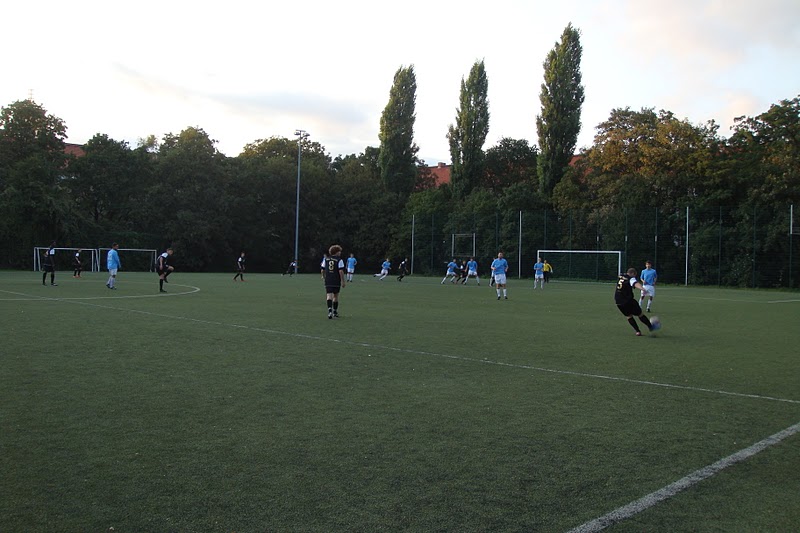
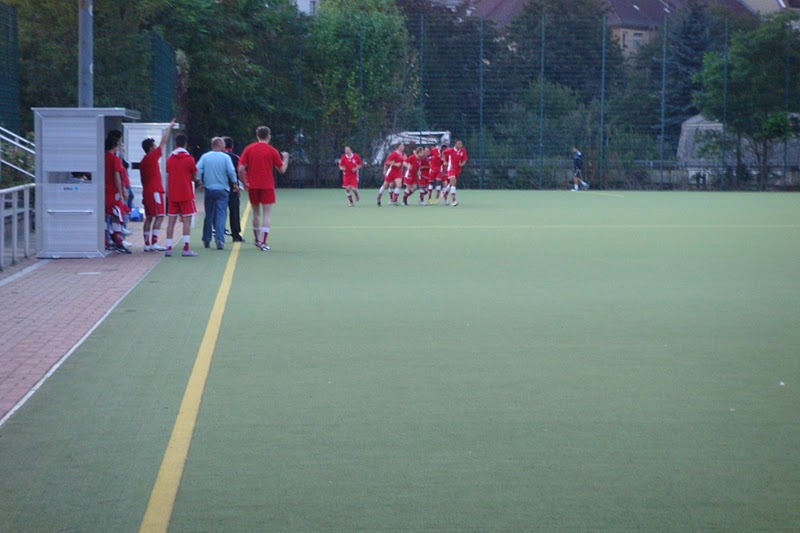
Friedrich-Ebert-Stadion KR1 (Capacity 500)
BFC Viktoria 89 - SpVgg Tiergarten (12:1) (A-Junior Landesliga, 15th September 2011)
Attendence: 58
Cost: Free
Programme: Nil
Thursday, September 15, 2011
Sunday, September 11, 2011
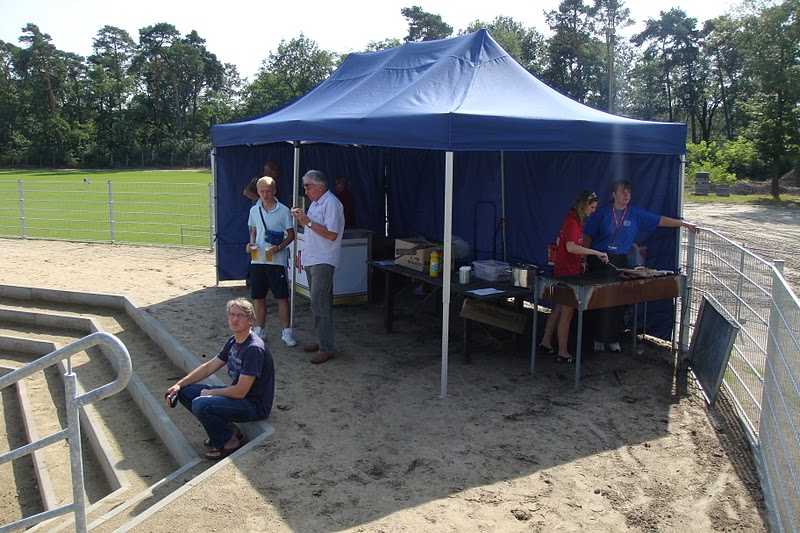
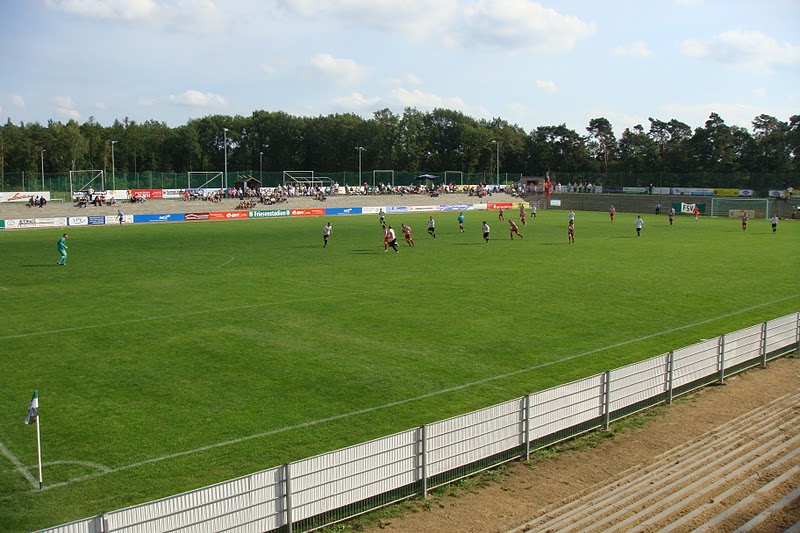
FSV Union Fürstenwalde
Friesenstadion (Capacity 10.000)
Fürstenwalde - FC Anker Wismar (3:1) (Oberliga Nord, 11. September 2011)
1:0 C. Mlynarczyl (24.), 2:0 R. Richter (36.), 3:0 M. Haubitz (37.), 3:1 L. Toure (84.)
Attendence: 612
Cost: 6 Euro
Programme: Union Live (1 Euro)
HISTORY:
In the wake of a merger between the clubs SG 1919 Union Fürstenwalde and FSV Wacker Fürstenwalde a new association called Union Fürstenwalde was founded in 1933. This football team wasn't able to achieve any significant success until 1945.It had to disbanded after the war ended because of a ban placed by the occupying Soviets. In its place, in 1946 a new sports club was founded called Fürstenwalde, which renamed itself in 1950 to Union SG Fürstenwalde. Although at that time, most independent sports communities were converted under the sponsorship of local businesses and institutions, Union SG Fürstenwalde were able to maintain their financial independence until 1958. During 1958 the club was restructured and became Fürstenwalde. In 1961, joined rivals BSG Motor rivals and became TSG Fürstenwalde. The football team in 1952 became one of the founding teams of the Frankfurt district league after they had played previously in one of the the East German districts of Brandenburg in the national league. In 1959, BSG became district champions and qualified for the third-class II DDR-Liga . The playing strength of the team however was not enough to stay up more than 1 year, and the team was back in the district league in 1960. In 1963, TSG was district champion again, but missed qualifying for the DDR-Liga II with a 4th Place in the promotion round. In the following years the team languished in the middle of the local league Frankfurt (Oder), however by the end of the 1970/71 season it was down in 13th Place. At the same time the East German security subordinate Dynamo Sports Association made plans for a new youth center in range of the Berliner FC Dynamo . Because there was already a dynamo team in Frankfurt, the Dynamo officials chose the location of the county town Fürstenwalde. Moreover Fürstenwalde possessed the then 4000-seater Rudolf Harbig stadium. Due to the declining balance of the TSG team it was merged with Dynamo Frankfurt who had qualified for the East German league, to form Dynamo Fürstenwalde. This new team joined the 1971-72 season in the East German league, where it stayed until 1977 ranked in the middle of table. 1978 however gave a 10th Place. The following year, the team rose to second place with thanks to Gerd Pröger (Tor), Klaus Malzahn (defense) and Captain Peter Wötzel (midfield). Immediately BFC Dynamo stepped in and stole these talented players for themselves as well as young players like Peter Kaehlitz and Lüdtke Kuhlke and to strengthen their team. The coach Egon Rohde was left with a squad that was only sufficient for the second division. In their first East German league year in 1979/80, theteam sensationally won 1st place in the B League Season. This provided a chance to be promoted to the top tier however a fifth place in the playoffs was all that could be mustered. A total of 19 players were used that season, whose average age was 23.1 years. The starting eleven had an average age of 23.9 years. By the end of the GDR football operations in 1990, Dynamo Fürstenwalde had achieved a further two second placing in the DDR II, however never made it to the 1.Liga. The plan to supply BFC Dynamo with mature players was only partially realised. Only a few players like Fürstenwalder Burkhard Reich (102 league games), Torsten Boer (32) and Peter Kaehlitz (9) where used by BFC. Despite several outstanding seasons there were on average only 1,100 spectators at home games. After the political changes of 1989, the football team merged for the short term with BSG Lok Fürstenwalde and played under that name in the 1990/91 season in the district league and reached the Frankfurt League after winning the League that year. The team lasted in the Frankfurt league until relegation in 1996 to the fifth tier of football. In 1996 a merger with FSV Wacker to become Wacker Fürstenwalde was performed causing a drop to the 6th League. In 1998 re-promotion to the fifth division, was achieved and maintained until 2006. The club, now renamed as FSV Union Fürstenwalde 1919, spent the next two seasons in the Landesliga (Tier 7),before winning promotion back to the Brandenburg-Liga (Tier 6) for the 2008/09 season. Following their win in the 2010/11 season the team won promotion for the Oberliga Nord.
HONOURS:
DDR-Liga (II) Staffel B Champions: 1979–80 as SG Dynamo Fürstenwalde
FDGB-Pokal best result: 1988–89 third round
Brandenburg-Liga (VI) champions: 2010–11
Fürstenwalde - FC Anker Wismar (3:1) (Oberliga Nord, 11. September 2011)
1:0 C. Mlynarczyl (24.), 2:0 R. Richter (36.), 3:0 M. Haubitz (37.), 3:1 L. Toure (84.)
Attendence: 612
Cost: 6 Euro
Programme: Union Live (1 Euro)
HISTORY:
In the wake of a merger between the clubs SG 1919 Union Fürstenwalde and FSV Wacker Fürstenwalde a new association called Union Fürstenwalde was founded in 1933. This football team wasn't able to achieve any significant success until 1945.It had to disbanded after the war ended because of a ban placed by the occupying Soviets. In its place, in 1946 a new sports club was founded called Fürstenwalde, which renamed itself in 1950 to Union SG Fürstenwalde. Although at that time, most independent sports communities were converted under the sponsorship of local businesses and institutions, Union SG Fürstenwalde were able to maintain their financial independence until 1958. During 1958 the club was restructured and became Fürstenwalde. In 1961, joined rivals BSG Motor rivals and became TSG Fürstenwalde. The football team in 1952 became one of the founding teams of the Frankfurt district league after they had played previously in one of the the East German districts of Brandenburg in the national league. In 1959, BSG became district champions and qualified for the third-class II DDR-Liga . The playing strength of the team however was not enough to stay up more than 1 year, and the team was back in the district league in 1960. In 1963, TSG was district champion again, but missed qualifying for the DDR-Liga II with a 4th Place in the promotion round. In the following years the team languished in the middle of the local league Frankfurt (Oder), however by the end of the 1970/71 season it was down in 13th Place. At the same time the East German security subordinate Dynamo Sports Association made plans for a new youth center in range of the Berliner FC Dynamo . Because there was already a dynamo team in Frankfurt, the Dynamo officials chose the location of the county town Fürstenwalde. Moreover Fürstenwalde possessed the then 4000-seater Rudolf Harbig stadium. Due to the declining balance of the TSG team it was merged with Dynamo Frankfurt who had qualified for the East German league, to form Dynamo Fürstenwalde. This new team joined the 1971-72 season in the East German league, where it stayed until 1977 ranked in the middle of table. 1978 however gave a 10th Place. The following year, the team rose to second place with thanks to Gerd Pröger (Tor), Klaus Malzahn (defense) and Captain Peter Wötzel (midfield). Immediately BFC Dynamo stepped in and stole these talented players for themselves as well as young players like Peter Kaehlitz and Lüdtke Kuhlke and to strengthen their team. The coach Egon Rohde was left with a squad that was only sufficient for the second division. In their first East German league year in 1979/80, theteam sensationally won 1st place in the B League Season. This provided a chance to be promoted to the top tier however a fifth place in the playoffs was all that could be mustered. A total of 19 players were used that season, whose average age was 23.1 years. The starting eleven had an average age of 23.9 years. By the end of the GDR football operations in 1990, Dynamo Fürstenwalde had achieved a further two second placing in the DDR II, however never made it to the 1.Liga. The plan to supply BFC Dynamo with mature players was only partially realised. Only a few players like Fürstenwalder Burkhard Reich (102 league games), Torsten Boer (32) and Peter Kaehlitz (9) where used by BFC. Despite several outstanding seasons there were on average only 1,100 spectators at home games. After the political changes of 1989, the football team merged for the short term with BSG Lok Fürstenwalde and played under that name in the 1990/91 season in the district league and reached the Frankfurt League after winning the League that year. The team lasted in the Frankfurt league until relegation in 1996 to the fifth tier of football. In 1996 a merger with FSV Wacker to become Wacker Fürstenwalde was performed causing a drop to the 6th League. In 1998 re-promotion to the fifth division, was achieved and maintained until 2006. The club, now renamed as FSV Union Fürstenwalde 1919, spent the next two seasons in the Landesliga (Tier 7),before winning promotion back to the Brandenburg-Liga (Tier 6) for the 2008/09 season. Following their win in the 2010/11 season the team won promotion for the Oberliga Nord.
HONOURS:
DDR-Liga (II) Staffel B Champions: 1979–80 as SG Dynamo Fürstenwalde
FDGB-Pokal best result: 1988–89 third round
Brandenburg-Liga (VI) champions: 2010–11
Thursday, September 8, 2011
Eintracht Mahlsdorf
Sportplatz Am Rosenhag (Capacity 2.500)
Eintracht Mahlsdorf - 1. FC Wilmersdorf (3:1) (Berlin-Liga, 8. September 2011)
1:0 Zom (23.), 2:0 Fiedler (29.), 3:0 Rafael (74.), 3:1 Badtke (80.)
Attendence: 54
Cost: 5 Euro
Programme: Nil
CLUB HISTORY: (wiki)
Eintracht Mahlsdorf is a German association football club from the eastern city district of Mahlsdorf in Berlin. Eintracht was inititally established in 1896 as a gymnastics club by local youth, but not formally registered until the following year. Football was popular within the club from its earliest days and a football department was organized in 1912 with the team taking part in established local competition by 1916. World War I resulted in play being suspended in most parts of the country and not resumed until 1919. In 1923 many of Eintracht's footballers abandoned the lilac-and-white to play in the black-and-yellow of newly formed Adler Mahlsdorf. With the rise to power of the Nazis in the 30s, many clubs, including Eintracht and Adler, were disbanded and their memberships organized into sports associations sanctioned by the regime.
Following World War II the club played in the football competition that emerged in Russian occupied East Germany. Prior to the isolation of East Berlin from the rest of the city Mahlsdorf advanced past Hertha Zehlendorf and Spandauer SV to the quarter finals of the 1949 Berlin Cup where they were put out by Berliner SV.
Beginning in 1955 the side played as Medizin Lichtenberg as it was identified with the larger city district that included Mahlsdorf and, like other East German clubs, associated with a specific industry. The club was renamed Medizin Mahrzan in 1982 – once again for a larger city district – and then in 1987 was dubbed Medizin Berlin 1896.
After German re-unification the club reclaimed its traditional name and registered as an independent entity on 3 June 1999. Following the merger of the two football competitions in Germanys 1991, Mahlsdorf played in the fourth tier Verbandsliga Berlin but was immediately relegated to the Landesliga Berlin (V) before slipping still further into local league play. The team eventually returned to the Landesliga and after a second place result in 2002–03 made their way back to what was now the fifth tier Verbandsliga Berlin. Mahlsdorf currently plays in the Verbandliga (Berlin-Liga) after being relegated in 2005 and then re-promoted in 2006.
Eintracht Mahlsdorf - 1. FC Wilmersdorf (3:1) (Berlin-Liga, 8. September 2011)
1:0 Zom (23.), 2:0 Fiedler (29.), 3:0 Rafael (74.), 3:1 Badtke (80.)
Attendence: 54
Cost: 5 Euro
Programme: Nil
CLUB HISTORY: (wiki)
Eintracht Mahlsdorf is a German association football club from the eastern city district of Mahlsdorf in Berlin. Eintracht was inititally established in 1896 as a gymnastics club by local youth, but not formally registered until the following year. Football was popular within the club from its earliest days and a football department was organized in 1912 with the team taking part in established local competition by 1916. World War I resulted in play being suspended in most parts of the country and not resumed until 1919. In 1923 many of Eintracht's footballers abandoned the lilac-and-white to play in the black-and-yellow of newly formed Adler Mahlsdorf. With the rise to power of the Nazis in the 30s, many clubs, including Eintracht and Adler, were disbanded and their memberships organized into sports associations sanctioned by the regime.
Following World War II the club played in the football competition that emerged in Russian occupied East Germany. Prior to the isolation of East Berlin from the rest of the city Mahlsdorf advanced past Hertha Zehlendorf and Spandauer SV to the quarter finals of the 1949 Berlin Cup where they were put out by Berliner SV.
Beginning in 1955 the side played as Medizin Lichtenberg as it was identified with the larger city district that included Mahlsdorf and, like other East German clubs, associated with a specific industry. The club was renamed Medizin Mahrzan in 1982 – once again for a larger city district – and then in 1987 was dubbed Medizin Berlin 1896.
After German re-unification the club reclaimed its traditional name and registered as an independent entity on 3 June 1999. Following the merger of the two football competitions in Germanys 1991, Mahlsdorf played in the fourth tier Verbandsliga Berlin but was immediately relegated to the Landesliga Berlin (V) before slipping still further into local league play. The team eventually returned to the Landesliga and after a second place result in 2002–03 made their way back to what was now the fifth tier Verbandsliga Berlin. Mahlsdorf currently plays in the Verbandliga (Berlin-Liga) after being relegated in 2005 and then re-promoted in 2006.
Saturday, September 3, 2011
SV Empor Berlin
Friedrich-Ludwig-Jahn-Sportpark Kleines Stadion (Capacity 5.000)
SV Empor - SF Charlottenburg Wilmersdorf (6:0) (Berliner Pilsner Pokal, 3.September 2011)
1:0 Schön (33.), 2:0 Habel (34.), 3:0 Brand (57.), 4:0 Stritter (74.), 5:0 Brand (87.), 6:0 Celina (90.)
Attendance: 55
Cost: 6 Euro
Programme: Nil
Last SV Empor Berlin visit:
SV Empor Berlin vs Torgelower SV Greif, 06. July 2011
SV Empor - SF Charlottenburg Wilmersdorf (6:0) (Berliner Pilsner Pokal, 3.September 2011)
1:0 Schön (33.), 2:0 Habel (34.), 3:0 Brand (57.), 4:0 Stritter (74.), 5:0 Brand (87.), 6:0 Celina (90.)
Attendance: 55
Cost: 6 Euro
Programme: Nil
Last SV Empor Berlin visit:
SV Empor Berlin vs Torgelower SV Greif, 06. July 2011
Friday, September 2, 2011
SV Nordern-Nordwest
Kokswiese KR1 (Capacity 2.000)
SV Nordern-Nordwest - Tennis Borussia Berlin (3:2) (Berliner Pilsner Pokal, 2. September 2011)
1:0 Puhlmann (18.), 2:0 Puhlmann (52.), 2:1 Dejagah (54.), 2:2 Kirstein (65.), 3:2 Fink (OG.)(78.)
Attendence: 250 (165 paying)
Cost: 6 Euro
Programme: Nil
SV Nordern-Nordwest - Tennis Borussia Berlin (3:2) (Berliner Pilsner Pokal, 2. September 2011)
1:0 Puhlmann (18.), 2:0 Puhlmann (52.), 2:1 Dejagah (54.), 2:2 Kirstein (65.), 3:2 Fink (OG.)(78.)
Attendence: 250 (165 paying)
Cost: 6 Euro
Programme: Nil
Nordern-Nordwest was founded in the year 1898 as 'North Berliner FC'. In 1906 the club merged with 'FC North-West Berlin' to become 'North-Northwest FC Berlin'. The team competed in and won the championship of the Football Association Markischen in 1905/06. They also competed in the German Championship in 1905/06 and reached the quarter-finals in Berlin, defeated by the German champions VfB Leipzig 1:9.
In 1907 the club merged with 'Teutonia 1903 Schonholz'to become 'SC North-Northwest Berlin'. Then in 1922 the name was changed to 'SV North-Northwest'. In 1907/08 NNW again reached the final of the championship Märkische but lost 3:4 against Viktoria 89 Berlin. Until 1933, the NNW continuously played in the Oberliga Berlin, in were placed mostly the upper third of the table. Their greatest success was winning the Berlin championship in 1922. In the ensuing 1921/22 German Cup NNW reached the semifinals but suffered a 0-1 defeat against 1.FC Nuremberg. In 1924 and 1926 NNW again reached the Berlin final, but lost to Hertha Berlin and Berlin Alemannia 90 respectively. In the extremely successful twenties NNW won in 1922 and 1925, the Berlin Association Cup. In the thirties the club could no longer build on the successes and missed qualification for the Gauliga Berlin-Brandenburg. In 1944 NNW formed a syndicate with the BFC Meteor 06 and functioned under the name 'KSG Meteor/NNW Berlin'. BFC Meteor 06 had made the ascent in the sport Gauliga, but declined to participate.
In 1945 the club disbanded and as SG Gesundbrunnen was reestablished in 1949, divided the sporting community in the area between NNW SV and Hertha BSC. The club played until 1961 in the amateur division of Berlin and subsequently disappeared from the higher category football. Current league is the Landesliga Berlin.
HONOURS:
Finals participation German Championship: 1905/06, 1921/22, 1925/26
Master Märkischer Football Association: 1905-06
Berlin Master: 1921/22
Berlin Cup Winners: 1923, 1925
In 1907 the club merged with 'Teutonia 1903 Schonholz'to become 'SC North-Northwest Berlin'. Then in 1922 the name was changed to 'SV North-Northwest'. In 1907/08 NNW again reached the final of the championship Märkische but lost 3:4 against Viktoria 89 Berlin. Until 1933, the NNW continuously played in the Oberliga Berlin, in were placed mostly the upper third of the table. Their greatest success was winning the Berlin championship in 1922. In the ensuing 1921/22 German Cup NNW reached the semifinals but suffered a 0-1 defeat against 1.FC Nuremberg. In 1924 and 1926 NNW again reached the Berlin final, but lost to Hertha Berlin and Berlin Alemannia 90 respectively. In the extremely successful twenties NNW won in 1922 and 1925, the Berlin Association Cup. In the thirties the club could no longer build on the successes and missed qualification for the Gauliga Berlin-Brandenburg. In 1944 NNW formed a syndicate with the BFC Meteor 06 and functioned under the name 'KSG Meteor/NNW Berlin'. BFC Meteor 06 had made the ascent in the sport Gauliga, but declined to participate.
In 1945 the club disbanded and as SG Gesundbrunnen was reestablished in 1949, divided the sporting community in the area between NNW SV and Hertha BSC. The club played until 1961 in the amateur division of Berlin and subsequently disappeared from the higher category football. Current league is the Landesliga Berlin.
HONOURS:
Subscribe to:
Posts (Atom)